
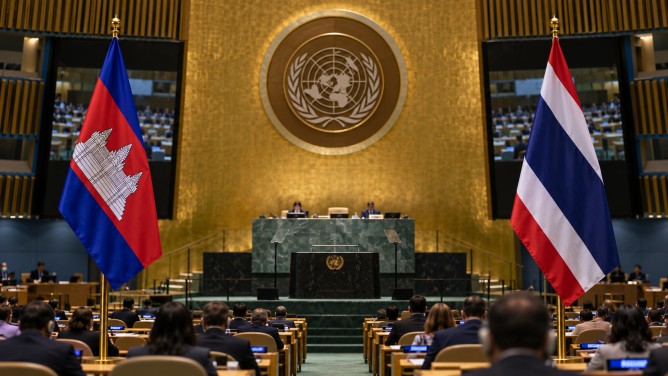
At the United Nations General Assembly, Cambodia and Thailand found themselves at odds over a lingering border dispute. Both nations emphasized the need for greater trust and cooperation, yet each accused the other of insufficient efforts to reach a resolution. The clash highlights ongoing tensions between the two Southeast Asian countries, which have yet to settle their differences over land and maritime boundaries.
Cambodia’s Foreign Affairs Minister, Prak Sokhonn, urged Thailand to adhere to existing bilateral agreements and resume efforts to survey and demarcate the contentious border area. He also called for the return of displaced civilians to their homes. Sokhonn pointed out that recent tensions have strained bilateral ties and impacted both civilians and cultural heritage. Emphasizing the importance of trust, he insisted that both countries honor previous commitments and abide by international law to avoid further escalation.
In addressing the maritime dispute, Cambodia expressed a commitment to resolving the issue through international legal frameworks. Sokhonn mentioned that Cambodia had initiated compulsory conciliation under the United Nations Convention on the Law of the Sea after Thailand withdrew from a 2001 Memorandum of Understanding that had guided maritime negotiations. Conversely, Thailand argued that the conciliation process should focus solely on maritime boundary delimitation.
Thai Prime Minister Anutin Charnvirakul called on Cambodia to engage in genuine bilateral dialogue to rebuild trust. He proposed enhanced cooperation in border security, demining efforts, and combatting online scams prevalent in the region. Despite a ceasefire that ended a 21-day confrontation last year, unresolved border issues continue to generate diplomatic friction.
Both countries, while expressing their respective positions, acknowledged the importance of international cooperation and peaceful dispute resolution. Cambodia has reiterated its preference for resolving disputes using existing agreements and international norms, while Thailand has stressed the significance of bilateral discussions and collaborative efforts to ensure border security.
The call for cooperation at the UN underscores the necessity for sustained diplomatic engagement. As both nations navigate their complex relationship, the international community remains a critical arena for addressing and potentially resolving their outstanding differences.